What Food Safety Alerts Can Teach Product Developers: Turning RASFF and FDA Recalls into Better Formulations
Recall notices usually go to QA. Read by product developers, they become an early warning about ingredients, suppliers, labels and packaging.
Alchemyst Team
September 27, 2026
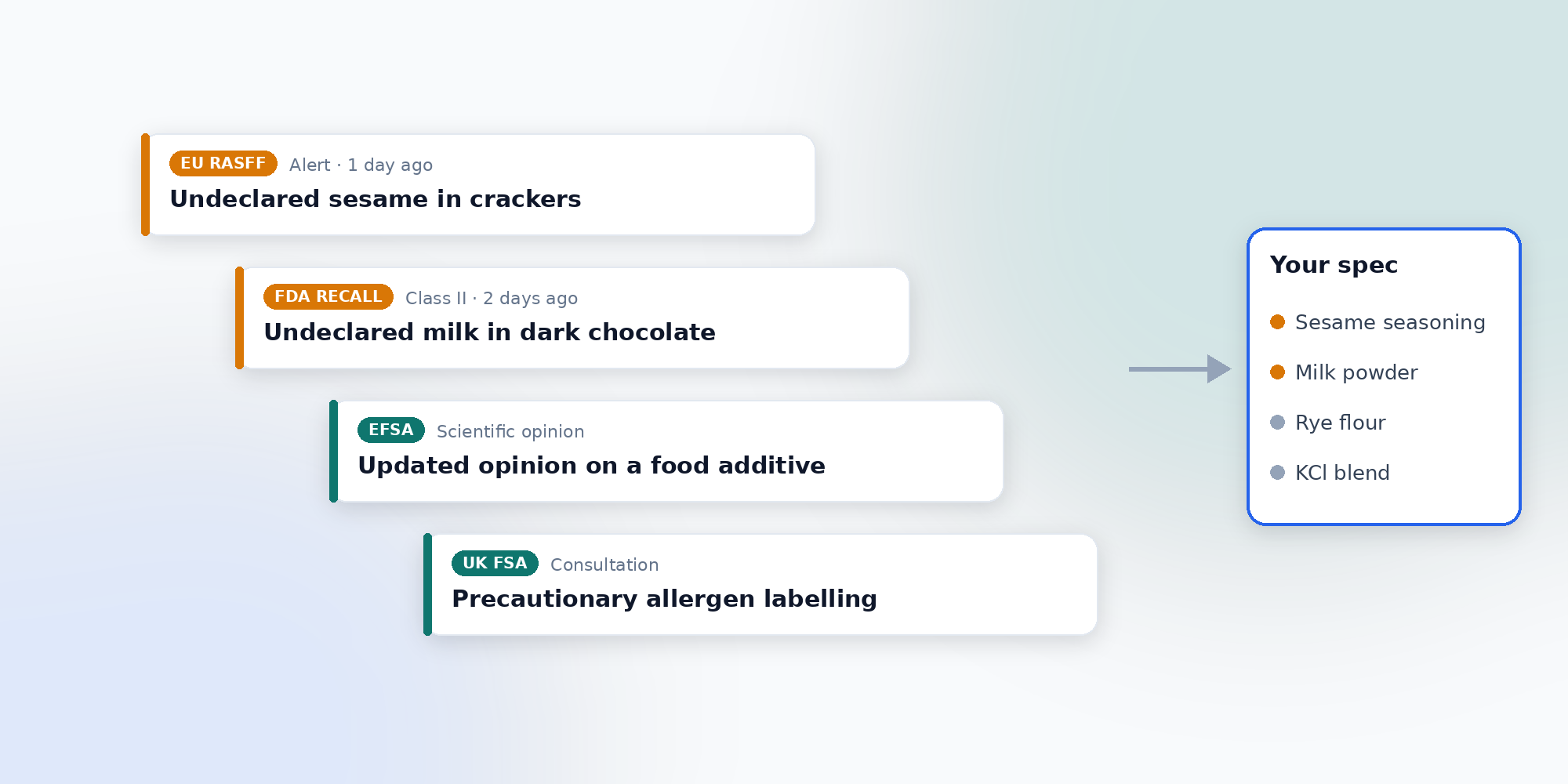
In most food companies, recall notices and food safety alerts land on the desk of quality assurance. That makes sense: QA owns the response when something goes wrong. But the same alerts are one of the most honest data sets product developers can get. Every notification is a small case study of an ingredient, a supplier region, a label or a package that failed somewhere in the real world. Read the right way, they tell you what to design out of your next product before it ever reaches a pilot plant.
This article looks at the main alert systems a food R&D team should know, what recent EU data says about where problems cluster, and a lightweight weekly routine that turns a noisy stream of notifications into decisions a formulator can act on.
The alert systems worth knowing
EU: RASFF
The European Union's Rapid Alert System for Food and Feed (RASFF) lets national authorities in the EU and EEA share information about food and feed risks. It sits inside the wider Alert and Cooperation Network, which also covers suspected fraud and administrative cooperation. RASFF notifications come in four types (see the European Commission's overview):
- Alert: a product with a serious risk is on the market and rapid action, such as a withdrawal, is needed.
- Information: either for follow-up (the risk doesn't need immediate action) or for attention (the product isn't on the market in other member countries).
- Border rejection: a consignment was refused at the EU border.
- News: other safety information that is useful to authorities.
For a product developer, border rejections are especially useful. They rarely make headlines, but they show which ingredients from which origins keep failing EU checks, which is exactly what you want to know before you approve a new supplier.
United States: FDA recalls
The U.S. Food and Drug Administration classifies recalls by the level of health hazard (FDA definitions). Class I means a reasonable probability of serious adverse health consequences or death. Class II covers temporary or medically reversible effects, or a remote probability of serious ones. Class III means adverse health consequences are unlikely. For R&D, the reason behind a recall matters more than its class. Undeclared allergens are a recurring cause, and since the FASTER Act took effect in 2023, sesame is the ninth major allergen that US labels must declare.
United Kingdom and Canada
The UK Food Standards Agency publishes Allergy Alerts, Product Recall Information Notices and Food Alerts for Action, and the Canadian Food Inspection Agency publishes recalls and allergy alerts. If you sell into these markets, their alerts belong in the same review as RASFF and the FDA, because allergen rules and enforcement priorities differ between them.
What the EU data says about where problems cluster
The European Commission's 2024 Alert and Cooperation Network annual report gives a useful picture of where notifications concentrate. RASFF recorded 5,250 notifications in 2024, 12% more than in 2023, and border rejections made up roughly a third of them (as summarised by FoodTimes). A few findings stand out for product developers:
- Fruits and vegetables were the largest product group (16% of notifications), driven mainly by pesticide residues in citrus, dried fruit and peppers.
- Nuts and nut products (7%) were dominated by aflatoxins in groundnuts and pistachios, with Salmonella often found in sesame seeds.
- Dietary foods, food supplements and fortified foods (7%) had 70% of cases flagged as potential fraud, mostly linked to online sales. Issues included unauthorised ingredients and titanium dioxide (E 171), which has not been allowed as a food additive in the EU since 2022.
- Cereals and bakery products (6%) were led by rice, with pesticide residues above EU limits as the main concern.
- Confectionery (3%) saw gummies as the most reported product, with cannabinoids, unauthorised additives and excessive colours among the issues.
- Food contact materials (3%) mostly involved migration from materials such as melamine tableware.
None of this is news to a QA manager. But for a formulator choosing between two spice suppliers, a sesame source, or a gummy format for a supplement, it is exactly the context that should shape the brief.
Five signals product developers should watch
1. Origin-linked hazards in your ingredients
Mycotoxins in nuts, pesticide residues in rice and spices, and Salmonella in seeds are not random. They cluster by ingredient and origin. When the same combination keeps appearing, build it into supplier approval and specification limits early, rather than discovering it through a failed incoming inspection.
2. Allergens and labelling
Undeclared allergens are one of the most common reasons for recalls, and the list of allergens differs between markets. The EU lists 14 in Annex II of Regulation (EU) No 1169/2011; the US now has nine. Alerts about undeclared milk in chocolate or sesame in crackers are reminders to check shared lines, rework and supplier declarations, not only the recipe.
3. Ingredients allowed in one market but not another
Titanium dioxide is the textbook example: still permitted in some markets, no longer allowed as a food additive in the EU. Alerts that mention unauthorised additives or novel ingredients are a cheap early warning for any product you plan to launch in more than one market.
4. Fraud-prone ingredients
Olive oil, herbs and spices, and supplements sold online appear again and again in fraud-related notifications. If your formulation depends on one of them, authenticity testing and a second qualified supplier are worth planning from the start.
5. Packaging and food contact materials
Migration issues are easy to overlook in a formulation brief, but packaging is part of the product. Notifications about contact materials are a prompt to involve packaging colleagues before the format is fixed.
A 30-minute weekly routine
You don't need to read every notification. What works for most teams is a short, fixed review once a week:
- Filter first. Only look at the product categories you develop and the markets you sell into. Everything else is noise for R&D.
- Triage into three piles: act (it touches an ingredient, supplier or claim in an active project), watch (relevant to the category, not yet to a project) and ignore.
- Link every act item to a project. Add it to the project's brief or risk log so the decision survives the next hand-over.
- Write down what it means for you. For each relevant alert, one sentence on the consequence: a spec to tighten, a supplier question, a label to check.
- Review monthly for patterns. One alert is an incident. Five alerts about the same ingredient and origin are a design constraint.
Where AI helps, and where it doesn't
The hard part of this routine is not the reading. It is the filtering and connecting: separating the handful of alerts that matter to your categories and markets from the hundreds that don't, and linking them to the ingredients in your own projects. That is where AI assistants can save real time, by summarising alerts, grouping them by ingredient and market, and drafting a first answer to "what does this mean for us?".
What AI should not do is decide on its own. Whether an alert changes a specification, a supplier or a label is a judgement for the people who own the product, based on their own data and their regulatory advice. Good tools make that judgement faster and better informed. They don't replace it.
Conclusion
Food safety alerts are usually treated as a QA inbox. For product developers they are something more useful: a continuous, public record of what goes wrong with ingredients, suppliers, labels and packaging. A short weekly review, filtered to your categories and markets and linked to your projects, turns that record into fewer surprises at the pilot plant and fewer reformulations after launch.
Sources: European Commission, 2024 Alert and Cooperation Network annual report (2025); European Commission, ACN notifications; FoodTimes, EU Alert and Cooperation Network: 2024 Annual Report Analysis; U.S. FDA, Recalls Background and Definitions; Regulation (EU) No 1169/2011.
The alerts that matter, every Monday
Alchemyst's Briefing gathers recalls, regulatory updates and research from sources including EU RASFF, the FDA, the UK FSA and CFIA, matched to the markets and categories you work in, with one click to ask what an alert means for your products.
Start free trialRelated Insights
Continue exploring the intersection of AI and food science

How AI Transforms Food R&D: Literature to Insight in Seconds
Alchemyst Team · Apr 13, 2026 · 8 min read
Read article →
Stage-Gate in Food Innovation: How AI Accelerates Every Phase
Alchemyst Team · Apr 13, 2026 · 9 min read
Read article →
Bioactive Compounds and Functional Foods: The Science Behind Health Claims
Alchemyst Team · Apr 13, 2026 · 11 min read
Read article →